
🎁 Premium content preview: This content is normally available only to Premium users. Explore it to see what Premium includes.
ESG Ahead Brief
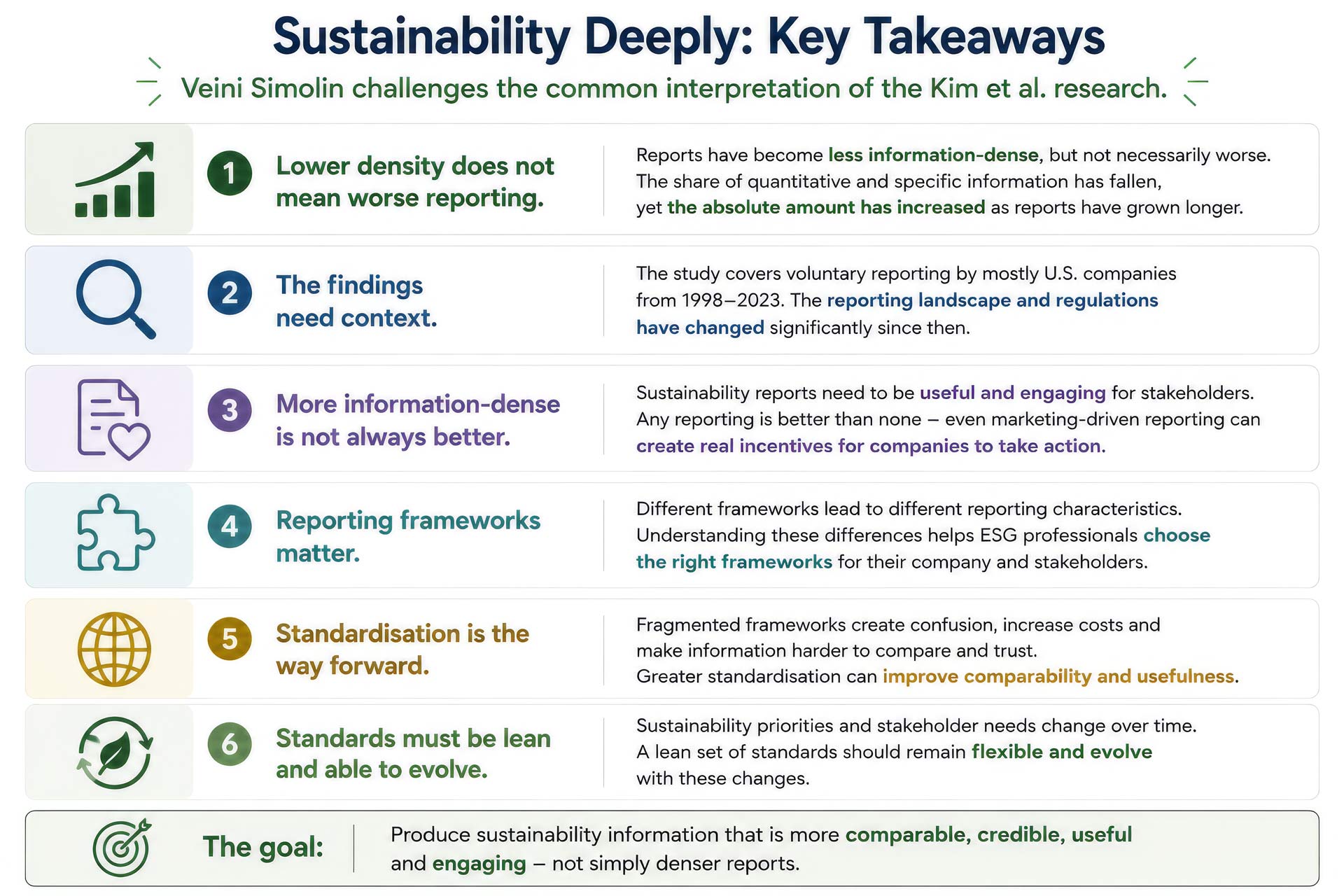
The Kim et al research has been widely interpreted as showing that sustainability reporting is getting worse. Veini Simolin challenges this conclusion. Sustainability reports have become less information-dense, but not necessarily worse: while the share of quantitative and specific information has declined, the absolute amount has increased as reports have grown longer. Veini argues that the bigger challenge is fragmented reporting frameworks. Greater standardisation, while keeping standards flexible enough to evolve, could make reporting more comparable and useful.
Key Takeaways
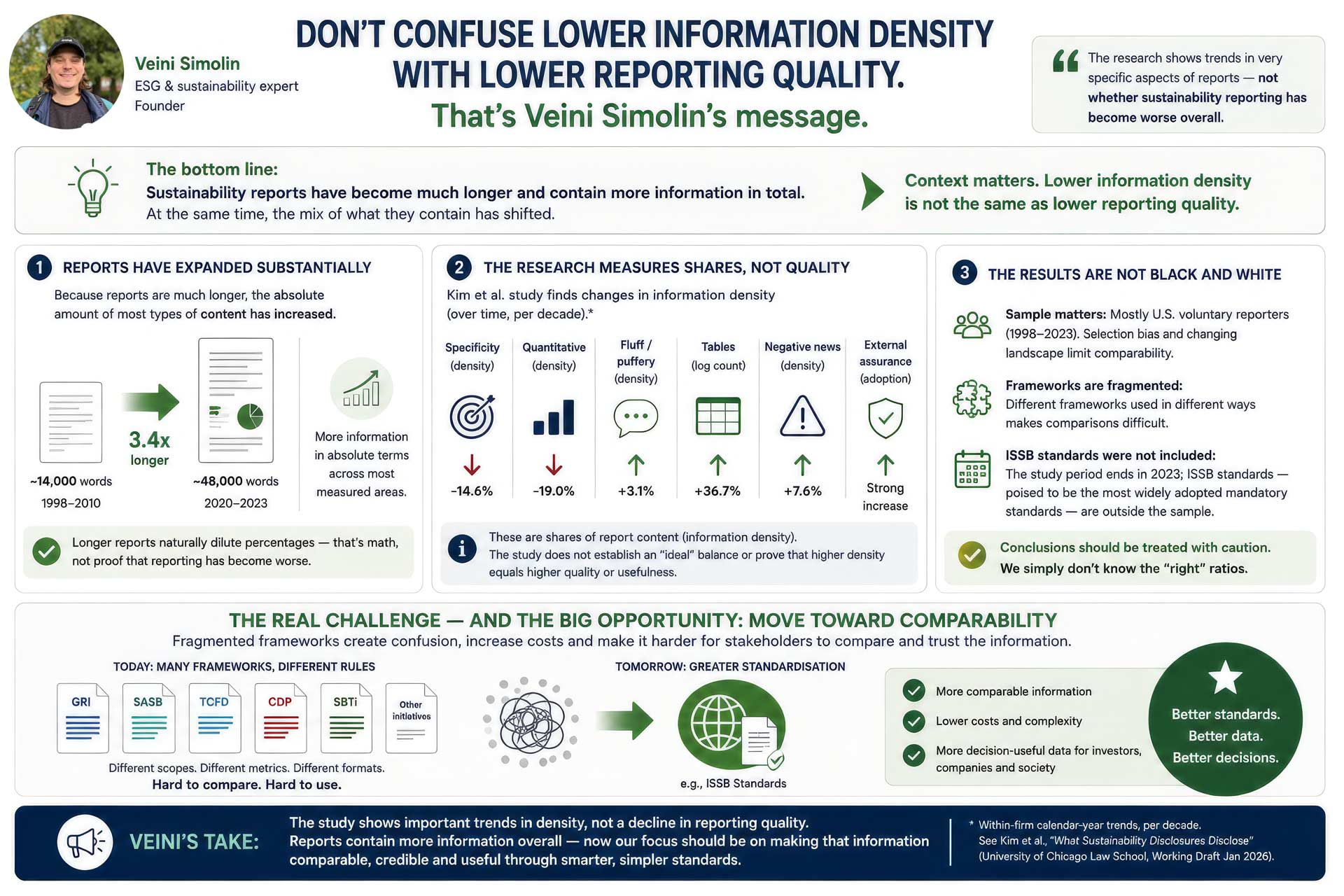
Veini Simolin challenges the common interpretation of the Kim et al research. He argues that falling information density should not be taken as evidence that sustainability reporting is getting worse, and highlights what ESG professionals should actually learn from the findings.
- Lower density does not mean worse reporting. Sustainability reports have become less information-dense, but they have also become much longer and contain more information overall.
- The findings need context. The study mainly covers voluntary reporting by U.S. companies from 1998–2023, while reporting frameworks and regulation have changed significantly.
- More information-dense is not always better. Sustainability reports also need to be useful and engaging enough for stakeholders to read and use them.
- Reporting frameworks matter. Understanding how different frameworks affect reporting can help ESG professionals choose approaches that fit their company and stakeholders.
- Standardisation is the way forward. A leaner and more comparable set of standards can reduce fragmentation, while still evolving as sustainability priorities and stakeholder needs change.
BLOG Story: You are wrong about the findings of the report published by Kim et al.

Author: Veini Simolin
Title: ESG and sustainability expert
Blog: Sustainability Deeply in LinkedIn
This is what most people have taken away from the report:
“Sustainability reporting expanded markedly after 2015: more firms entered, more governance frameworks were adopted, and reports lengthened substantially. But on the characteristics stakeholders have demanded, reports moved in the opposite direction: over time they became less specific, less quantitative, and fluffier, with table counts rising modestly among established reporters and negative news roughly flat.”
While this quote of course tracks with the findings in the paper the conclusions people are drawing are wrong. People seem to associate the trend in these very specific aspects of the reports with the reports becoming worse over time. This is not necessarily the case for a few reasons.
The biggest and most obvious reason is that in fact the absolute amount of all of the aspects of the reports (specific statements, quantitative statements, fluffiness, table count and negative news) have increased due to the length of the reports increasing. Even the writers of the report seem to be of two minds regarding this topic. On one hand they say that the base level of the reports is disappointing and that the reports don’t live up to stakeholder expectations, while at the same time acknowledging the fact that all of the aspects measured grew in absolute terms and even stating that they don’t know the optimal ratios of the different aspects of the reports.
“On the measures that stakeholders have demanded, sustainability reports are generally doing worse over time. Figure 7 plots disclosure characteristics by year for all reporters (black), new reporters (yellow), and established reporters that first reported in 2015 or earlier (green). Over time, reports have become less specific, less quantitative, and fluffier. But table counts have risen somewhat among established reporters (controlling for report length), and negative news has fluctuated among new reporters and changed little for established ones.
Changes, however, occurred off an already-disappointing base: It is impossible to know the “right” ratio of quantitative, fluff, and negative sentences, but reports contain twice as much fluff (~27%) as quantitative sentences (~13%) and nearly four times as much fluff as negative news (~7%). See Appendix Table A2. To be clear, our measures are relative shares (ratios and length-normalized scores) rather than absolute counts. As pre-registered, we focus on information density: the share of a report devoted to quantitative, fluff, or negative content, rather than raw quantities. This distinction matters because the absolute counts of nearly every measure rose over the period as reports expanded.
We thus document changes in density (fewer quantitative sentences per total number of sentences), not necessarily a loss of content (there are more quantitative sentences in report on average overall over time).”
This means that we don’t even know how far from the optimal situation the current state of play in voluntary reporting is. Making the conclusions drawn based on these statements suspects at the very least.
Another point that will colour the conclusions one can draw from the article is the sample used. The adoption of different frameworks was highly varied between the companies reducing comparability (which was indeed admitted by the authors of the paper in the paper itself), and the sample was comprised mostly of American companies that had adopted voluntary reporting frameworks. This in itself creates the possibility of a selection bias, a topic also discussed by the authors. Additionally, the landscape of sustainability reporting has changed massively in the time the sample is from (1998-2023). This also poses challenges in interpreting the data. The paper also excluded the adoption of the ISSB which is a shame considering that the ISSB is poised to be the most widely adopted standard for mandatory reporting globally. In fact, this fracturing of the frameworks is the precise reason the ISSB standards have been developed. Subsequently would be interesting to see an update of this paper a few years on where the ISSB has been included in the study.
“In response to heavy criticism about the proliferation of different reporting frameworks, the International Sustainability Standards Board took over and consolidated several sets of reporting standards, including the SASB Standards, TCFD Recommendations, and others (but not GRI), to create the IFRS S1 General Requirements for Sustainability-related Disclosures and the IFRS S2 Climate-related disclosures.95 IFRS continues to maintain the SASB Standards as part of its guidance (denoted as SASB Standards) while TCFD’s recommendations fully folded into the IFRS standards and TCFD disbanded.
As of April 2026, 40 jurisdictions around the world have adopted or are planning to adopt the IFRS standards.96 Because those IFRS standards apply outside of the date range of our sample, we do not discuss them further.”
Thirdly I would like to raise the question whether the trends we are seeing are truly a bad thing for sustainability reporting overall. Based on this statement it might seem so:
“…as reporting mainstreamed, reports became less specific, less quantitative, and fluffier.”:
However, if a more analytical approach is adopted the conclusions don’t seem so clear. When reporting became more mainstream even firms that don’t view sustainability as a core to their business and thus disclosure as a necessity have started reporting possibly due to external pressure from stakeholders. In this time the skills of sustainability professionals in marketing as well as the skills and interest of marketers to integrate sustainability into campaigns driven by consumer focus on the topic have grown. This means that there is more skill to create better fluff as well as more demand for customer facing “fluffy” reports.
“Despite the attention they receive, there are longstanding questions about the potential of voluntary sustainability disclosures to keep corporations accountable on their efforts to improve sustainability. Critics argue that because the disclosures are voluntary, and because corporations choose what information to include within them, the disclosures end up being little more than marketing.
The packaged food company Mondelez, for example, released a 2024 report full of beautifully shot photos of its products (Oreos, Ritz Crackers, and more) and statements like “Our Mission is to lead the future of snacking.”
Critics allege that the disclosures do not provide enough information for investors to accurately price securities,5 and contain a deluge of greenwashing or puffery that obfuscate what little real information is disclosed.6 More fundamentally, a lack of standardization across reports precludes meaningful cross-firm comparisons and obscures trends over time.”
Even though the release of reports might be seen at least partially as a marketing activity and the reports might not contain the most scathing information It would still seem like the better option to have companies looking towards sustainability reporting as an opportunity. What I mean by this is that even if some companies only decide to publish information on the fluffy good stuff it still means that they have to actually do some fluffy good stuff in order to be able to report it. In this case would it be better for there to not be any incentive for the company to do good, even if it now appears to be mostly for marketing or greenwashing purposes? If the situation was different and companies were not releasing anything, would they have any reason to do the flashy initiatives that get the headlines in the modern world? I am not arguing that increasing the transparency and standardisation of reporting is a bad thing, on the contrary I think it is necessary, but at the same time I believe that any reporting is better than none.
So, what should you actually take away from this report then?
The most interesting finding at least to me is how the different reporting frameworks relate to each other. Overall, the most interesting aspect of the paper in my opinion is not the corporate sustainability reports that were analysed, but what such an analysis can tell us about the different reporting frameworks themselves. For sustainability professionals work like this can help in selecting the frameworks(s) to use depending on the stakeholders that the reports are directed towards, as well as the needs of the specific company.
From the data we can see that companies believe that reporting is important, but does reporting well matter as much? I think it matters, and I think this paper confirms or at the very least doesn’t refute this assertion. The growing amount of “fluff” to me seems to suggest that at least superficial quality matters to companies. Reports being more information dense does not necessarily mean that reports are better. This is mainly because reports need to be engaging enough for people to find them worthy of reading. However, the reputational benefit for most companies might still very well be small, and indeed mostly linked to the perception of doing any reporting in the first place.
The recommendation the research team makes on the basis of the report is for us to standardise reporting – an effort that is currently ongoing globally. I think this is the correct recommendation based on the data and analysis provided. The fragmentation in the different reporting frameworks is most likely the culprit behind the wide variety of reports and data that we currently get from companies that report voluntarily. Another recommendation made by the researchers here is that the rules for reporting should not be fully set in stone, because the priorities for which sustainability topics are important change over time. This is also a very important note to make, and one regulators should take to heart. We need a lean set of reporting standards in order for the standards to reflect the needs of the stakeholders that use the reports at any given time.
Link to full paper: https://papers.ssrn.com/sol3/papers.cfm?abstract_id=7111640