

ESG Ahead Brief
Many organizations still approach sustainability as a compliance exercise driven by reporting requirements. In this discussion, Pasi Simolin and ESG expert Veini Simolin challenge that mindset by arguing that sustainability should become an integral part of business strategy. They explain how combining sustainability data with strategic planning helps organizations identify growth opportunities, reduce business risks, improve stakeholder relationships and generate measurable return on investment. Rather than asking how to comply with regulations, leaders should ask how sustainability can strengthen long-term competitiveness and business resilience.
Key Takeaways
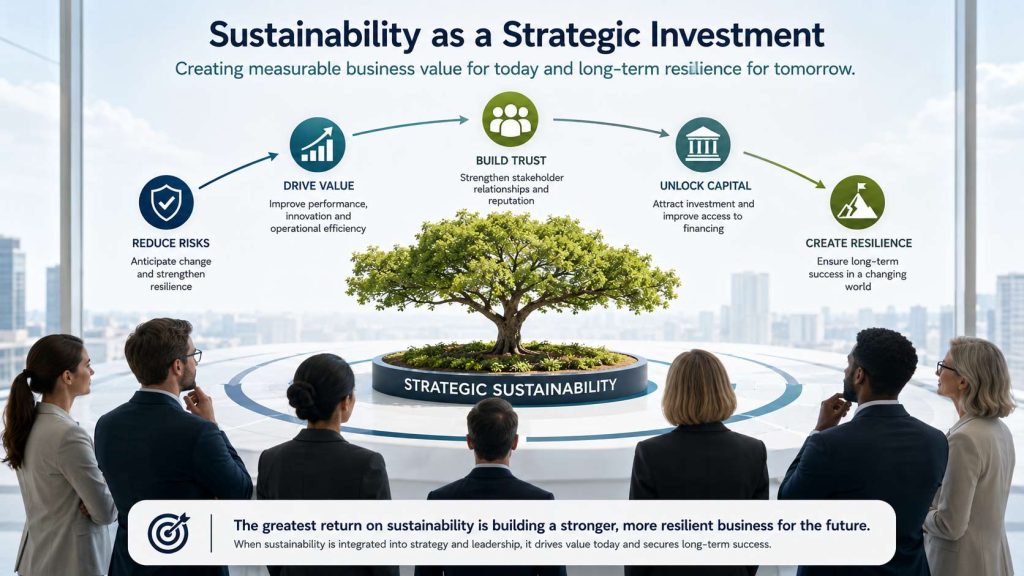
- Sustainability should shape business strategy. Organizations create more value when sustainability guides strategic decisions instead of remaining a reporting exercise.
- Business value extends far beyond compliance. Sustainability can improve competitiveness through stronger customer relationships, easier financing, better recruitment and lower business risks.
- Leadership—not a single sustainability manager—should own sustainability. CEOs and executive teams should integrate sustainability into everyday business management.
- Stakeholder insights are strategic assets. Customers, employees and partners often identify emerging risks and business opportunities earlier than management alone.
- Measure sustainability like any business investment. Organizations should evaluate sustainability initiatives by their return on investment, including financial performance, risk reduction and long-term company value.
- Long-term resilience is the ultimate ROI. The greatest success measure is whether the company remains competitive and profitable decades into the future.
Episode Summary
Sustainability Should Support Better Business Decisions
Podcast starts: 02:45
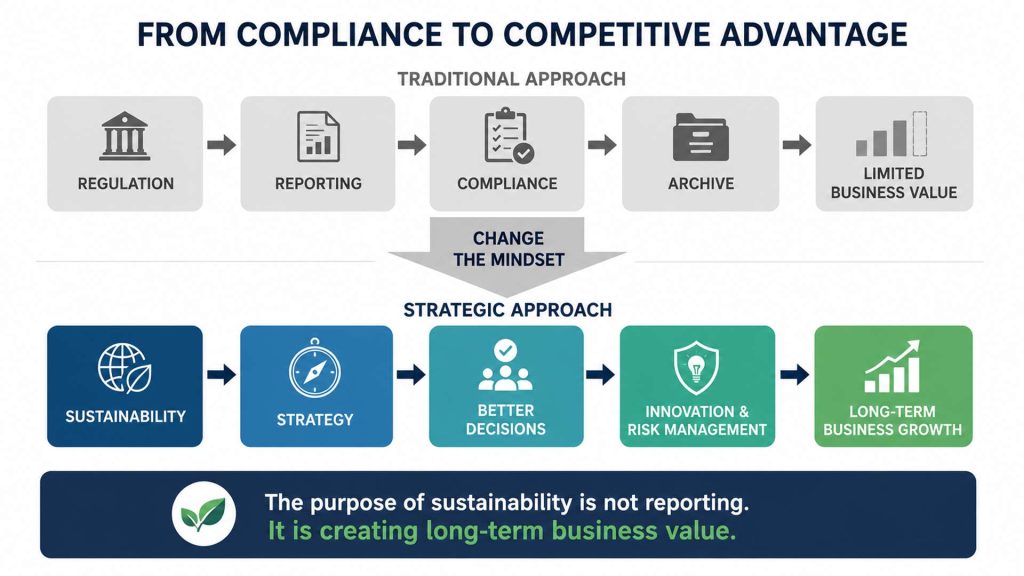
Many organizations still associate sustainability with complex legislation, reporting standards and administrative work. The speakers acknowledge that this perception is understandable because new regulations such as CSRD and ESRS have introduced significant reporting requirements. However, they argue that focusing only on compliance causes organizations to overlook the real purpose of sustainability.
According to the discussion, legislation acts as a catalyst that encourages companies to improve, but reporting should never become the final objective. The real value comes from using sustainability as a framework for making better business decisions, strengthening resilience and creating long-term competitive advantage.
Rather than asking “How do we complete the report?”, leadership should ask “How can sustainability help us build a stronger business?”
“We shouldn’t do sustainability just because we have to report it—we should do it because it builds a stronger business.”
— Veini Simolin (05:49)
Sustainability and Strategy Belong Together
Podcast starts: 07:01
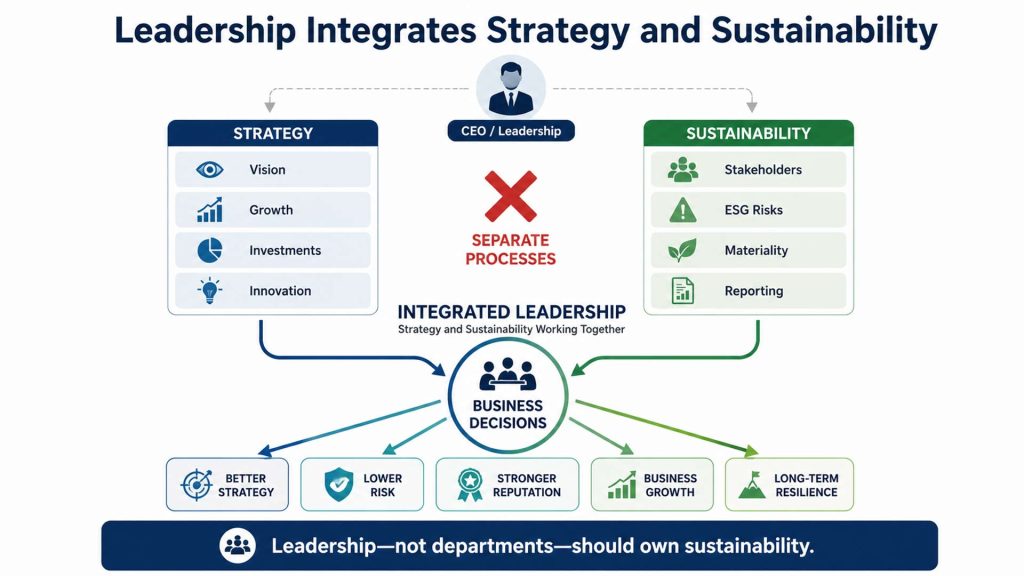
One of the strongest messages in the discussion is that sustainability should not be delegated to a single specialist or department. Instead, it should become a leadership responsibility alongside strategy.
The speakers argue that many organizations unintentionally isolate sustainability into its own process. When this happens, valuable stakeholder insights, sustainability data and risk assessments remain disconnected from strategic planning. As a result, organizations invest significant time and money without fully benefiting from the information they collect.
Integrating sustainability and strategy allows the same information to support business planning, operational improvements and long-term investment decisions simultaneously.
“Sustainability and strategy should hold hands inside the organization.”
— Veini Simolin (08:24)
The discussion also highlights that stakeholder engagement should not be viewed as a reporting exercise. Customers, employees, suppliers and investors often identify emerging risks and opportunities before they become visible through traditional management reporting. Organizations that actively listen to these groups are better positioned to adapt and innovate.
Instead of treating sustainability as an independent project, leadership should embed it into every significant business decision.
Measuring the Return on Investment of Sustainability
Podcast starts: 11:58
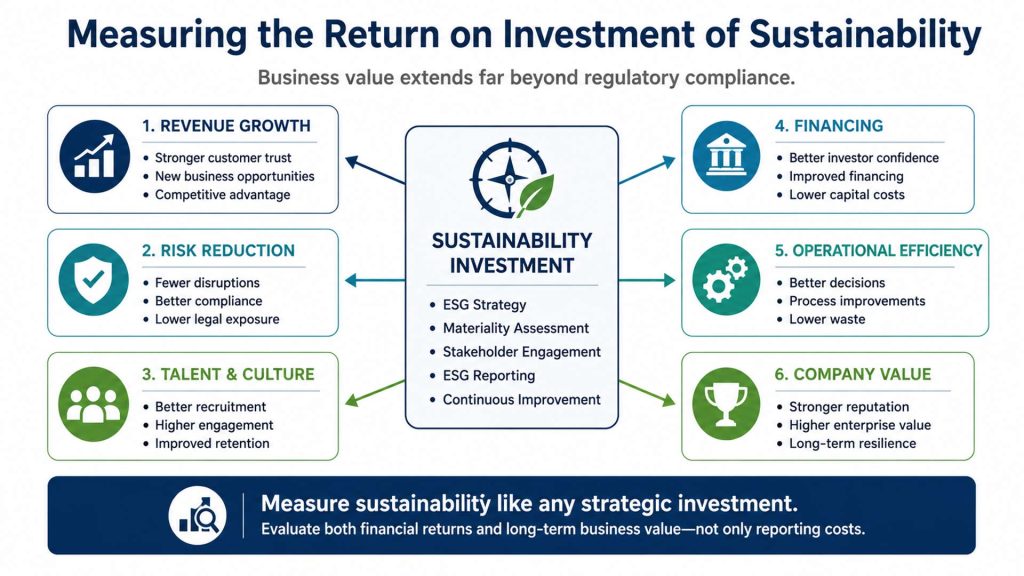
A common criticism of sustainability initiatives is that they are expensive while their business value remains difficult to quantify. The discussion challenges this perception by arguing that sustainability should be evaluated using the same business principles as any strategic investment.
The speakers explain that organizations often spend tens of thousands of euros annually on sustainability projects, reporting and consulting. However, very few companies systematically measure the business outcomes these investments generate. Instead of viewing sustainability as a cost, leadership should identify the multiple ways it contributes to organizational performance.
These benefits extend beyond direct financial returns. Improved employer branding can reduce recruitment costs, stronger customer trust can increase sales, and proactive risk management can prevent costly disruptions. Sustainability also supports operational efficiency by encouraging organizations to identify unnecessary waste, improve processes and make more informed investment decisions.
“Sustainability and strategy should be evaluated in exactly the same way—we should measure the value they create.”
— Pasi Simolin (12:37)
The discussion concludes that there is no single sustainability ROI metric. Instead, organizations should build a portfolio of measurable business impacts that together demonstrate the value created through sustainability initiatives.
Sustainability Helps Organizations Manage Business Risks
Podcast starts: 14:03
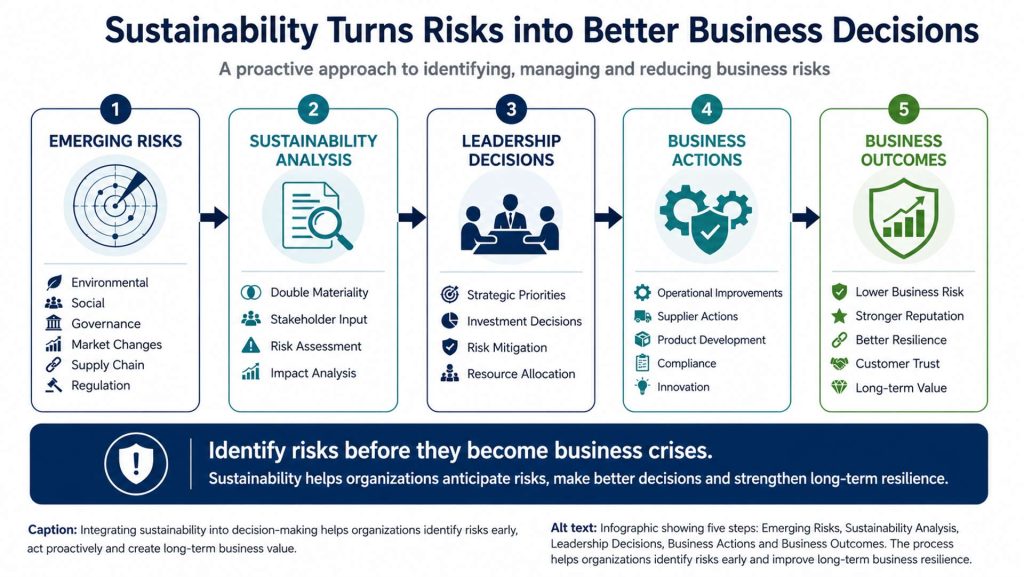
Risk management emerges as one of the strongest business arguments for sustainability. The speakers point to several well-known corporate crises where environmental or social failures significantly damaged company value and reputation.
Rather than viewing sustainability as a separate compliance activity, organizations should use it to identify potential risks before they become business problems. Double materiality assessments, stakeholder engagement and structured ESG analysis provide early warning signals that can influence strategic decisions long before a crisis occurs.
The discussion emphasizes that sustainability risks are rarely isolated environmental issues. They often affect customer trust, investor confidence, financing conditions, supply chains and ultimately the long-term viability of the business itself.
“Almost every major business risk is ultimately connected to sustainability.”
— Veini Simolin (14:40)
Preventing one major reputational crisis may generate a return that exceeds the total investment made in sustainability over many years. From this perspective, sustainability becomes an investment in resilience rather than simply a compliance requirement.
Sustainability Creates Value Across the Entire Business
Podcast starts: 17:26
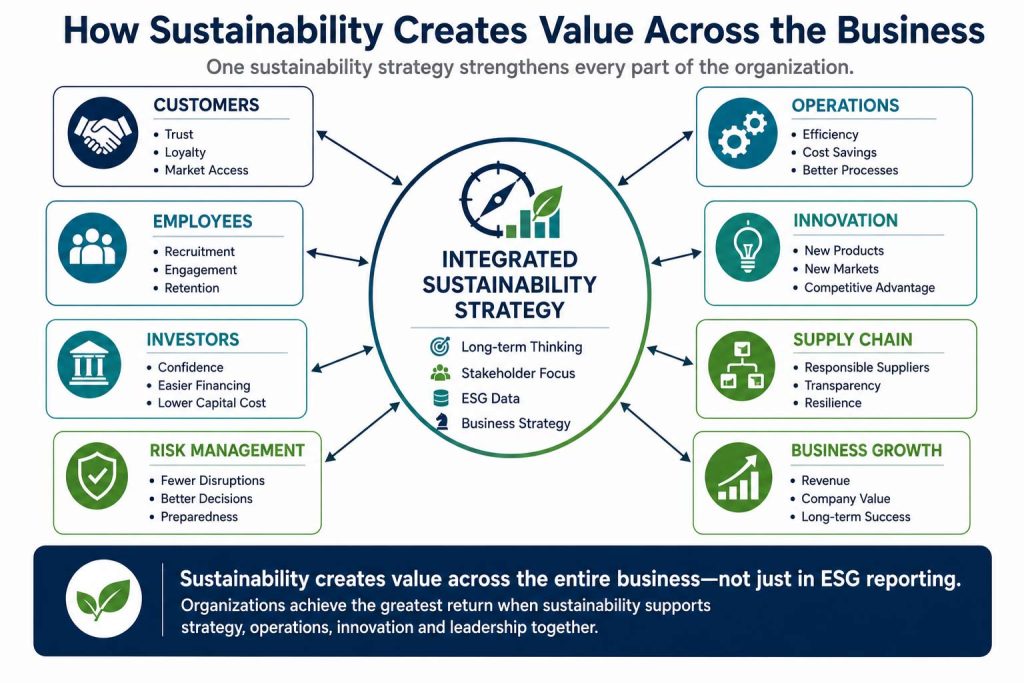
The conversation broadens the discussion from risk management to value creation. Sustainability can influence customer retention, employee engagement, financing opportunities and access to new markets. For companies operating within larger supply chains, demonstrating responsible business practices is increasingly becoming a prerequisite for winning and retaining business.
Financial institutions and investors are also placing greater emphasis on ESG performance. Better sustainability practices can improve financing conditions, strengthen investor confidence and help organizations remain attractive business partners as reporting requirements continue to expand throughout supply chains.
Rather than asking whether sustainability creates value, organizations should identify where that value appears inside their own business model. For some companies it may primarily improve recruitment, while for others it may strengthen customer relationships or reduce operational costs.
“For some companies, good sustainability can determine whether they win or lose important customers.”
— Veini Simolin (17:47)
The speakers conclude that measuring sustainability should always reflect each organization’s own business objectives rather than relying solely on standardized ESG metrics.
Creating Long-Term Business Resilience Through Sustainability
Podcast starts: 22:15
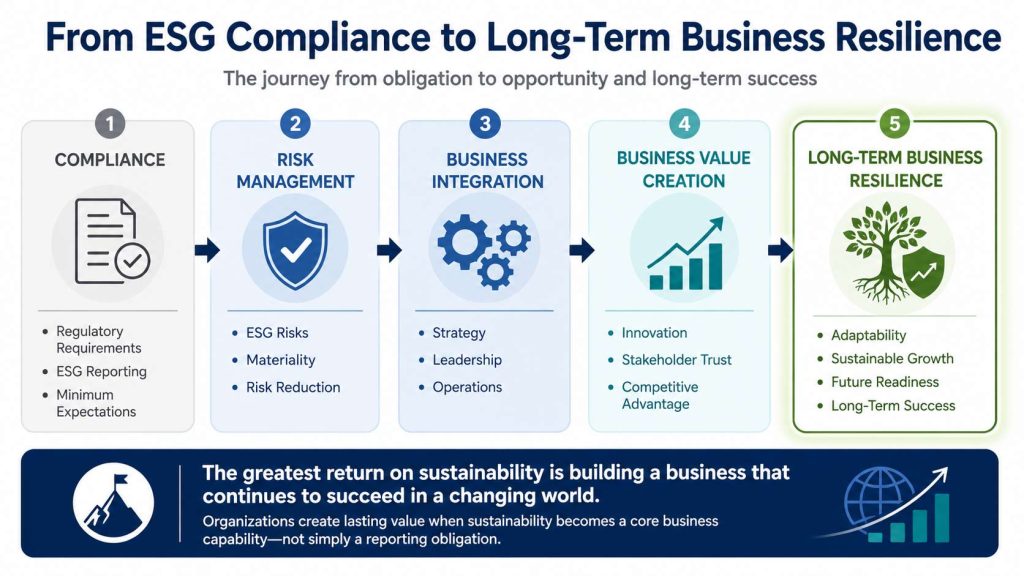
The discussion concludes by shifting the focus from individual sustainability initiatives to long-term organizational resilience. The speakers argue that the greatest return on sustainability investments may not be immediate financial gains, but the ability to remain competitive in an increasingly complex business environment.
Organizations face growing expectations from customers, investors, employees and regulators. Companies that proactively integrate sustainability into their business strategy are better positioned to adapt to changing market conditions, while those treating sustainability solely as a reporting obligation risk falling behind.
The conversation emphasizes that sustainability should not be viewed as a cost center. Instead, it is a capability that enables organizations to anticipate change, strengthen stakeholder relationships and continuously improve business performance.
“The biggest return on investment may simply be that the company still exists thirty years from now.”
— Veini Simolin (25:41)
Ultimately, sustainability is presented as a business capability rather than a compliance function. When integrated into leadership, strategy and daily decision-making, it helps organizations become more innovative, resilient and competitive over the long term. Companies that embrace this mindset are better prepared not only to manage today’s ESG requirements but also to respond successfully to future market changes.
Featured Speakers
Veini Simolin
Organisation: ExecutESG
Role: ESG Advisor and Founder
Veini Simolin advises organizations on integrating sustainability into business strategy and leadership. His work focuses on helping companies move beyond compliance by using ESG as a driver of business value, competitive advantage and long-term organizational capability.
Why his perspective is valuable
Veini combines practical ESG implementation experience with strategic business thinking, helping leaders understand how sustainability can improve decision-making rather than simply fulfil reporting obligations.
Pasi Simolin
Organisation: ExecutESG
Role: Podcast Host and Business Development Professional
Pasi Simolin leads discussions on leadership, business transformation and sustainability. He focuses on translating complex ESG topics into practical business conversations relevant to executives and decision-makers.
Why his perspective is valuable
Pasi challenges traditional thinking through practical questions that connect sustainability with everyday business management, helping executives understand the strategic implications of ESG.
Who Should Listen
ESG Managers
Gain practical ideas for demonstrating how sustainability contributes to business strategy and measurable business value.
Sustainability Directors
Learn how to position sustainability as a leadership capability rather than a reporting function.
CEOs
Understand why sustainability should become an integral part of strategic decision-making and long-term business growth.
CFOs
Discover how sustainability investments can generate value through improved resilience, financing opportunities and risk management.
Board Members
Learn how integrating sustainability into governance can strengthen competitiveness and support long-term value creation.
Risk Managers
See how ESG analysis and stakeholder engagement help identify emerging business risks before they become significant issues.
Sustainability Consultants
Gain practical arguments and frameworks for helping clients connect sustainability initiatives with strategic business objectives.
Future ESG Leaders
Develop a broader understanding of how ESG creates value beyond compliance and supports long-term organizational success.