

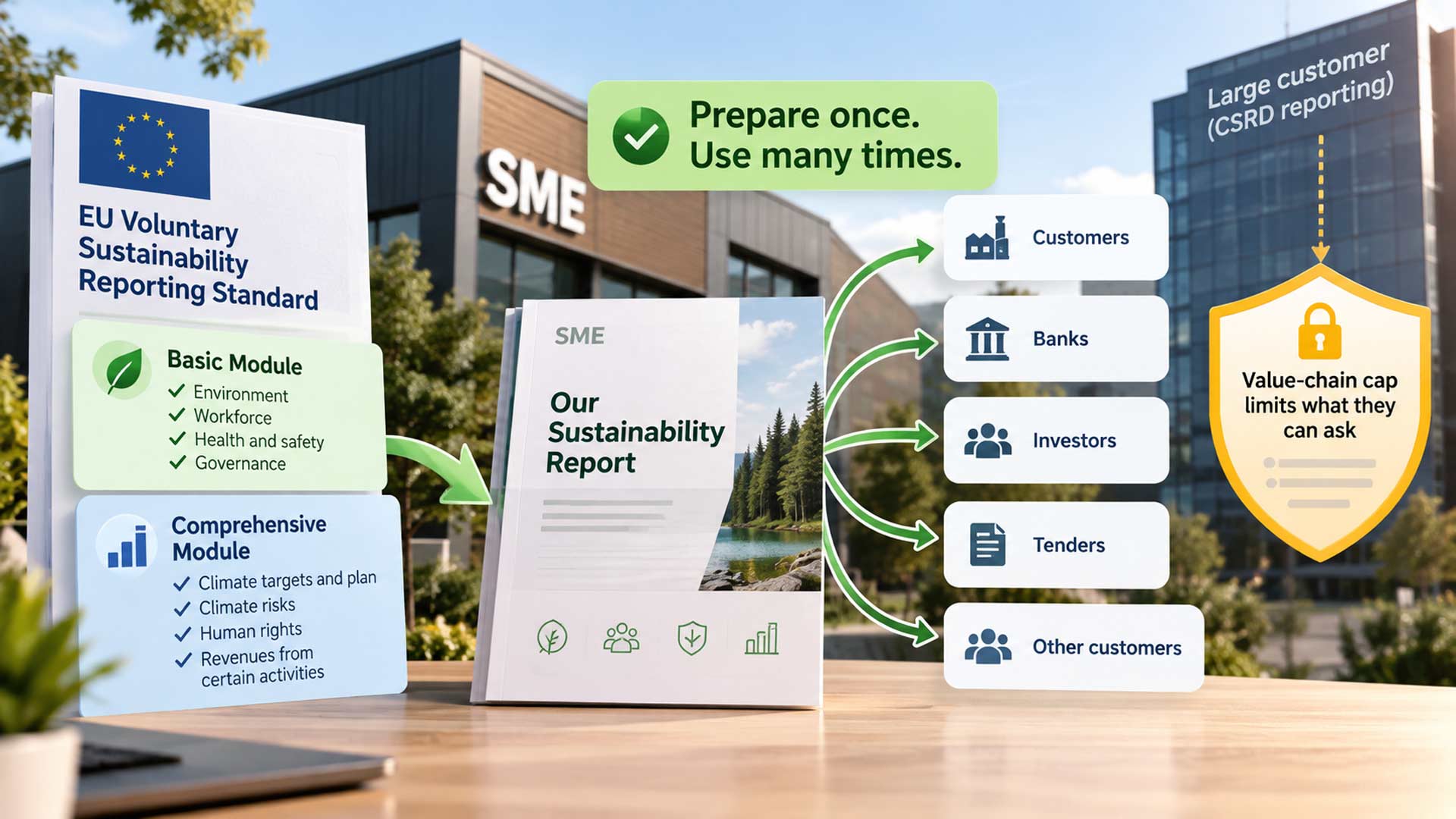
ESG Ahead Briefing
This content requires a membership. Please, log in or subscribe a Premium plan to continue and see the whole content.
A simple way to do it
See Example Reports
ESG Ahead Key Takeaways
Full Article
Why Sustainability Information Can Make Your SME Easier to Do Business With
Many SMEs (small and medium-sized enterprises) may be outside mandatory EU sustainability reporting. But that does not mean sustainability information disappears from their business relationships.
Large customers still need information from their value chains. Banks and investors may ask for it, while tenders and supplier assessments may also include sustainability questions.
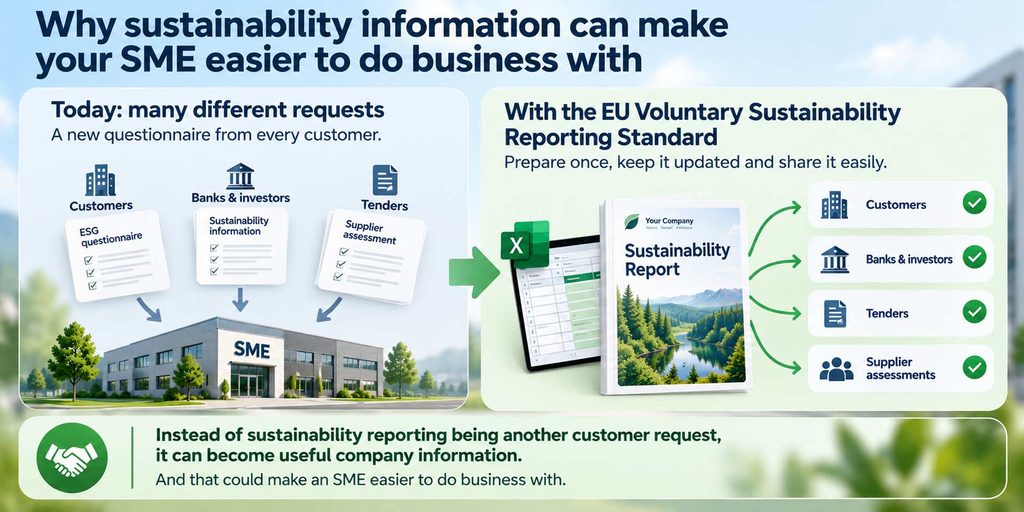
Until now, this has often meant a new questionnaire from every customer.
The new EU Voluntary Sustainability Reporting Standard creates an opportunity to approach this differently: prepare your sustainability information in advance, keep it updated and make it easy to share.
Instead of sustainability reporting being another customer request, it can become useful company information. And that could make an SME easier to do business with.
You may be outside CSRD, but customers may still need your information
One objective of the revised EU sustainability reporting rules is to reduce the reporting burden on smaller companies. But reducing mandatory reporting does not mean that customers no longer need sustainability information.
A large company reporting under CSRD may still need information about its value chain. Banks, investors, tenders and supplier assessments may also require sustainability information.
This is one reason why the EU introduced the Voluntary Sustainability Reporting Standard for companies outside mandatory sustainability reporting.
The standard is designed to help these companies provide information needed by value-chain customers, banks and investors. It is also intended to help companies manage sustainability issues and support competitive growth and resilience.
So although the reporting is voluntary, it can be an easy and practical way to make business more efficient, serve customers better and make your company easier to do business with.
The big change: Be ready before customers ask
Think about how sustainability information is often handled today.
A customer sends an ESG questionnaire, and someone starts looking for the answers. Energy data may be with finance or facilities, employee information with HR, while emissions calculations and policies are stored somewhere else.
Once everything has been collected, the answers are sent to the customer until another customer arrives with a slightly different questionnaire.
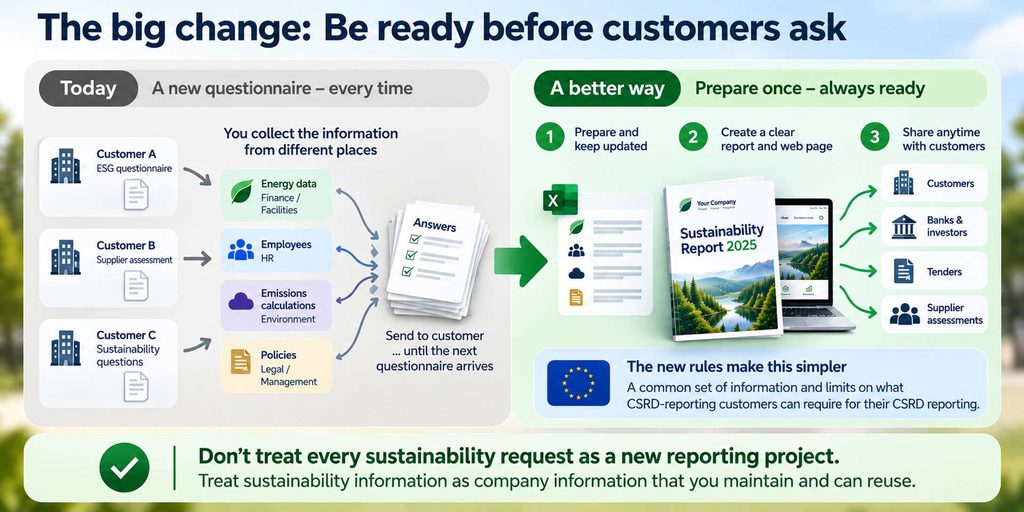
The Voluntary Standard offers a better way to work
Instead of waiting for each request, an SME can prepare its sustainability information in advance and keep it updated. It can be available 24/7 to customers, just like product information or marketing material. When a customer asks, the information is already there and ready to share.
The new rules make this simpler. They give SMEs a common framework to prepare and also limit what CSRD-reporting customers can ask from protected suppliers for their sustainability reporting. This helps protect smaller companies from unnecessary reporting work and repeated requests for different information.
Don’t treat every sustainability request as a new reporting project. Treat sustainability information as company information that you maintain and can reuse.
What is actually in the Voluntary Standard?
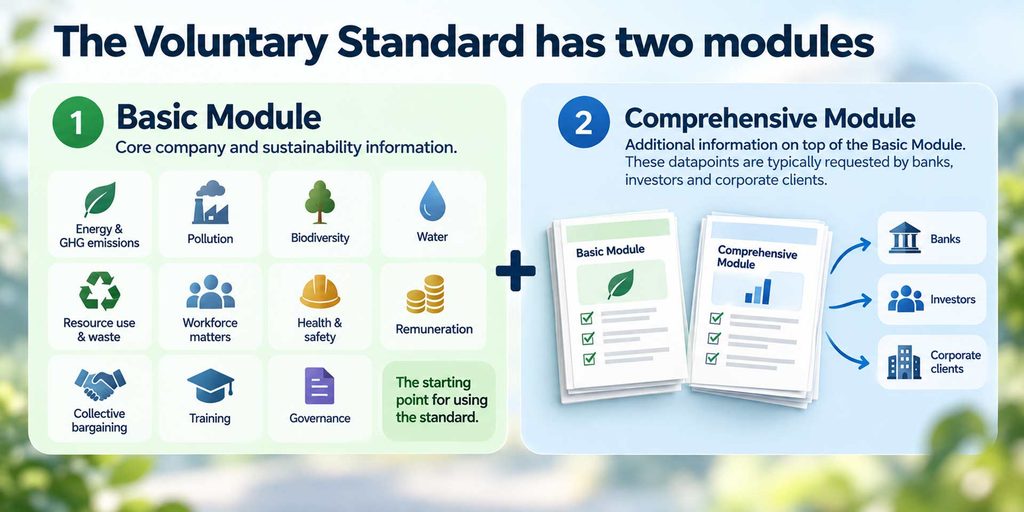
The standard has two modules:
- Basic Module
It contains the core company and sustainability information. It covers areas such as energy and greenhouse-gas emissions, pollution, biodiversity, water, resource use and waste, workforce matters, health and safety, remuneration, collective bargaining, training and governance. It is the starting point for using the standard. - Comprehensive Module
It adds information on top of the Basic Module. The regulation describes these additional datapoints as information likely to be requested by banks, investors and corporate clients.
A company must apply the Basic Module before applying the Comprehensive Module.
This tells us something important:
The standard isn’t designed only to create another sustainability report. It creates information that customers and financial stakeholders can use.
Prepare once in two useful formats
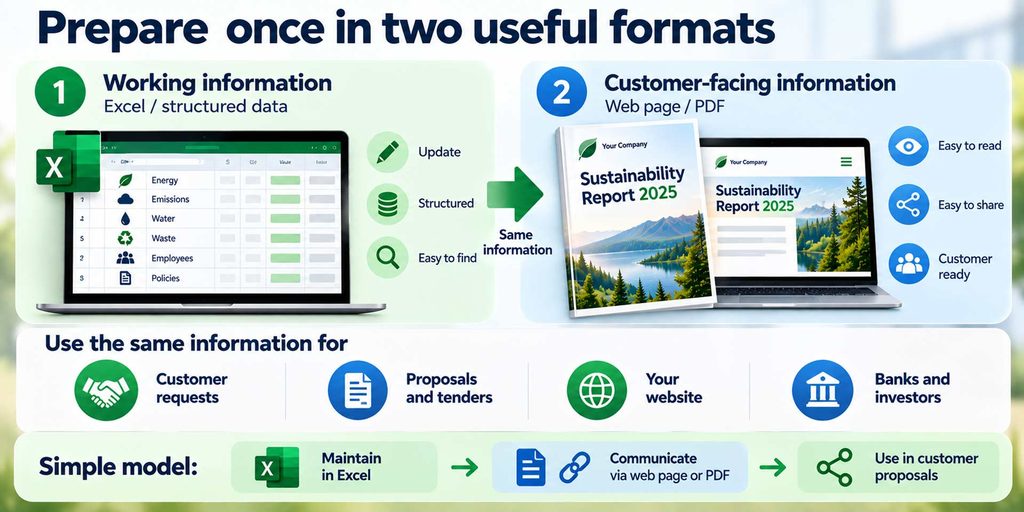
A sustainability report has two different jobs. The company needs an easy way to maintain the information, while customers need an easy way to read and use it.
We recommend a simple two-format approach:
- Working information (master data)
Excel / structured data, easy to update, individual datapoints are easy to find and use for customers, useful for customer questionnaires. - Customer-facing information
Web page / PDF, easy to read and share as well as suitable for customers, useful for proposals and tenders.
Keep the master information structured
A spreadsheet can work as the company’s sustainability information master. Instead of searching through old reports whenever someone asks for a number, the company maintains the underlying datapoints in one place.
This also follows the direction of European reporting tools. EFRAG has developed an Excel-based Digital Template for the earlier VSME framework and is updating its digital tools for the final 2026 Voluntary Standard.
Make the customer version easy to read
Customers should not have to work through a spreadsheet to understand the company.
Turn the same information into a clear sustainability report. This could be a web page that can be shared as a link or a PDF that can be sent to customers or attached to proposals and tenders.
The same information can then support:
- Customer requests:
Provide information without starting from zero. - Proposals and tenders:
Attach the report or share a link in communication and tender templates. - Your website:
Make sustainability information easy for potential customers to find 24/7. - Banks and investors:
Use the structured information when sustainability data is requested.
The Voluntary Standard allows the sustainability report to be made public, and its primary function is to inform actual or potential business counterparties.
So the model is simple:
So the model is simple:
Maintain the information in Excel or another structured format. Communicate it through a web page or PDF. Use both when needed in customer proposals.
See real examples of how companies are doing this →
The value-chain cap also helps smaller suppliers
The new rules don’t only give SMEs a framework for preparing information. They also limit some of the information demands that can flow down from CSRD-reporting companies.
A large company may need sustainability information from its suppliers for CSRD reporting. Those suppliers may then ask their own suppliers, creating a trickle-down effect throughout the value chain.
The new value-chain cap is intended to limit this effect for suppliers with up to 1,000 employees.
There is an important distinction: The Voluntary Standard and the value-chain cap are not the same thing.
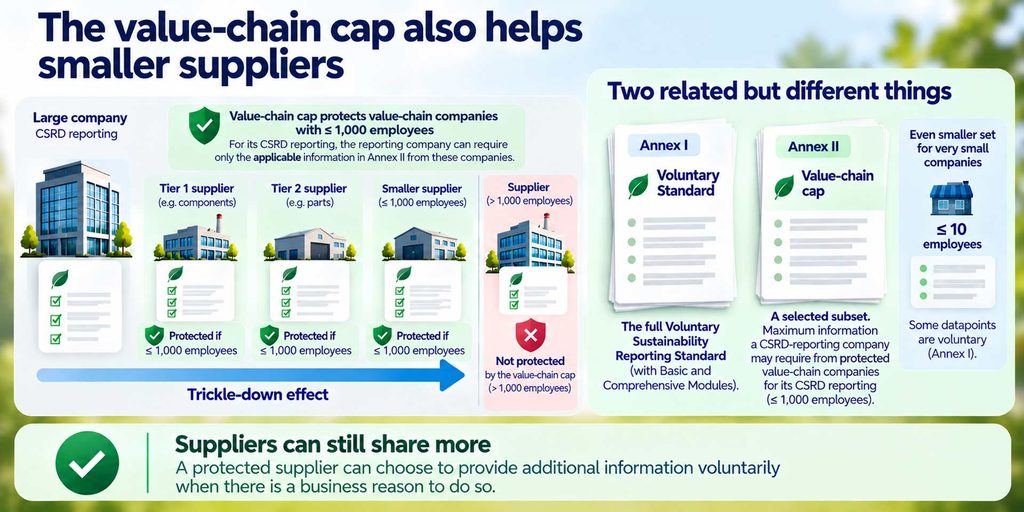
The Voluntary Standard in Annex I contains the full Voluntary Sustainability Reporting Standard, with the Basic and Comprehensive Modules.
The value-chain cap in Annex II is a selected subset of those datapoints. It defines the maximum information a CSRD-reporting company may require from a protected value-chain company for its CSRD reporting. For companies with 10 employees or fewer, the applicable set is smaller still.
See how the requirements compare in our other article:“Revised ESRS 2026: What Sustainability Information Do You Really Need From Suppliers?”
A protected supplier can nevertheless choose to provide more information voluntarily when there is a business reason to do so.
The opportunity is bigger than saving reporting time
The biggest opportunity may go beyond saving reporting time.
Imagine two suppliers competing for the same customer. One receives a sustainability questionnaire and starts collecting answers from finance, HR and operations. The other already has the information structured, can provide the requested datapoints and can send the customer a clear sustainability report.
That does not automatically make the second supplier more sustainable, and it does not guarantee that it will win the business.
But it can make the supplier easier to evaluate and easier to work with.
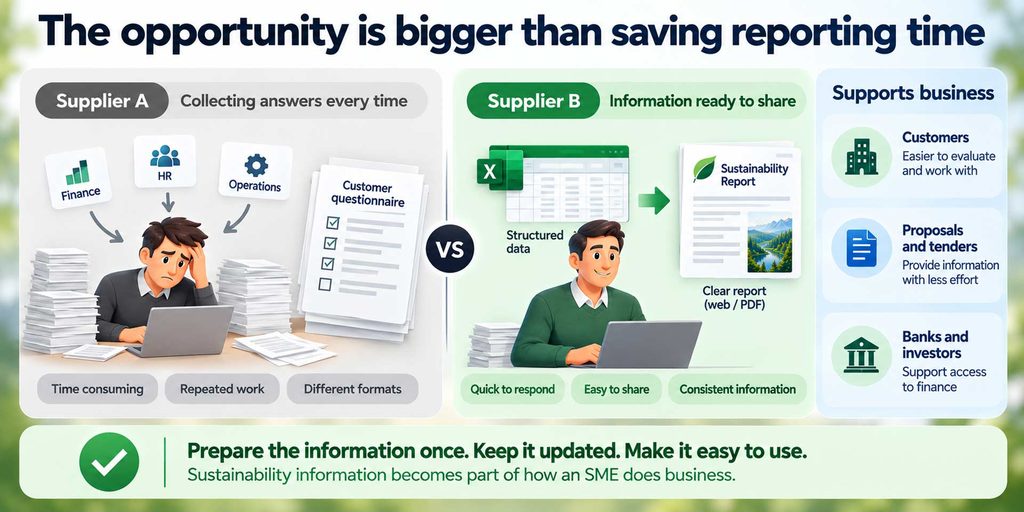
The same information can also support discussions with banks and investors. Helping companies satisfy their sustainability-information needs and supporting access to finance is one of the stated objectives of the Voluntary Standard.
Prepare the information once. Keep it updated. Make it easy to use.
Sustainability information can then become part of how an SME does business — rather than another questionnaire it has to complete.