

ESG Ahead Briefing
This content requires a membership. Please, log in or subscribe a Premium plan to continue and see the whole content.
Key Takeaways
Full Article
What actually changed?
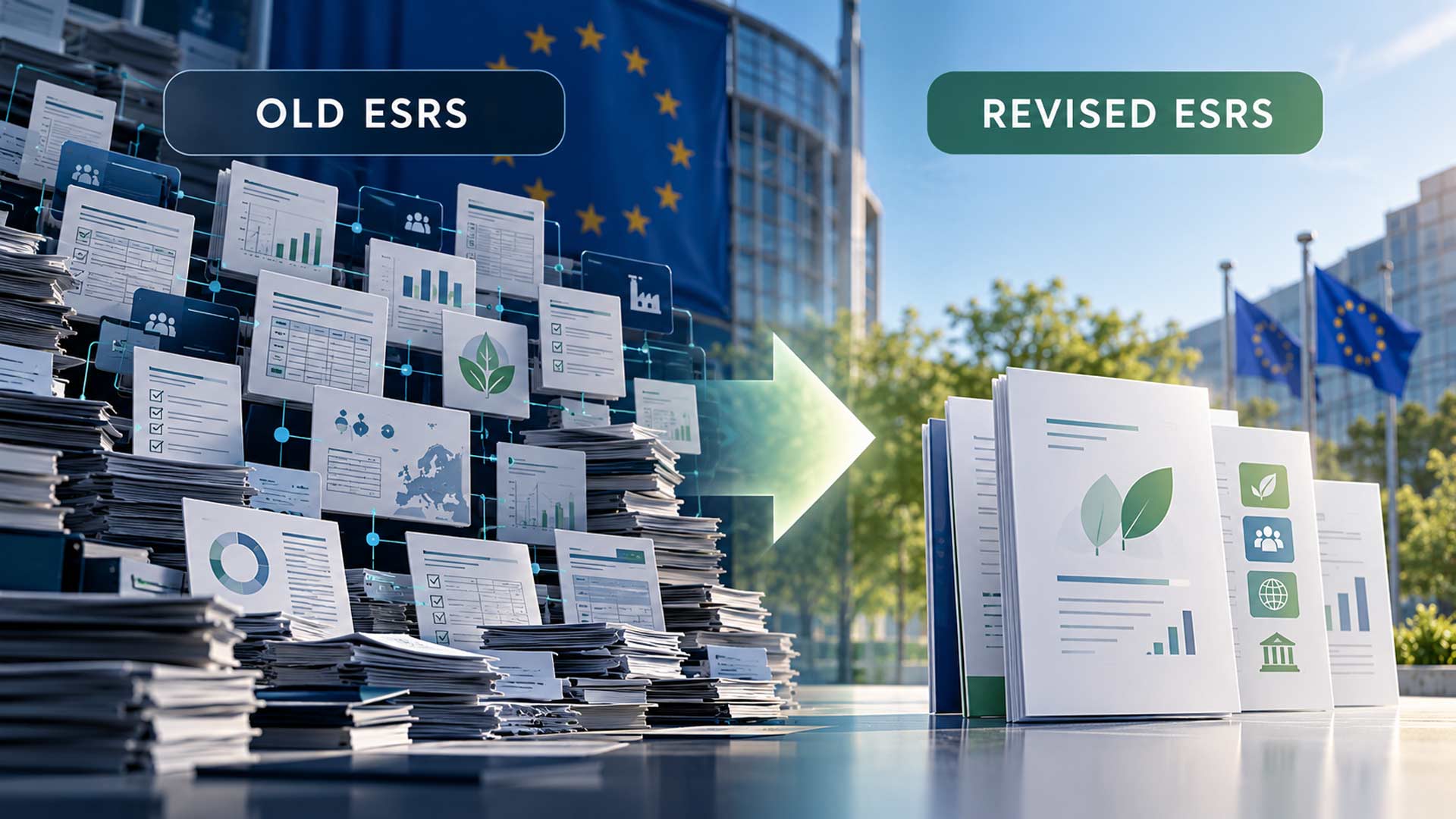
The revised ESRS are not simply a shorter version of the old standards.
Many requirements and datapoints have been removed. But there are also important changes in how companies can assess materiality, collect information and prepare their sustainability statement.
We compared the old and revised ESRS. Here are 16 changes that ESG managers should know.
1. There are far fewer datapoints, but not 60–70% less data
The original ESRS included a large number of datapoints. This created a lot of work in collecting, checking and reporting sustainability information.
The revised ESRS reduce mandatory datapoints by more than 60% and total datapoints by more than 70%.
However, fewer datapoints do not mean companies need 60–70% less sustainability data. Many datapoints containing overlapping information have been removed or combined. In practice, much of the underlying data companies need for reporting remains the same.
This is the most visible change, but the impact goes beyond a shorter report. Fewer and less overlapping datapoints can mean less reporting, control and assurance work. However, much of the underlying sustainability data may still be needed.

2. Materiality assessment is simpler
Double materiality was already at the centre of the old ESRS. But in practice, the assessment could become very detailed and complex.
The revised ESRS makes it clearer that companies do not need to assess every possible impact, risk and opportunity. They can focus on areas where material impacts, risks or opportunities are likely to exist based on their business, activities, locations and business relationships.
This supports a more focused, top-down approach to materiality assessment.

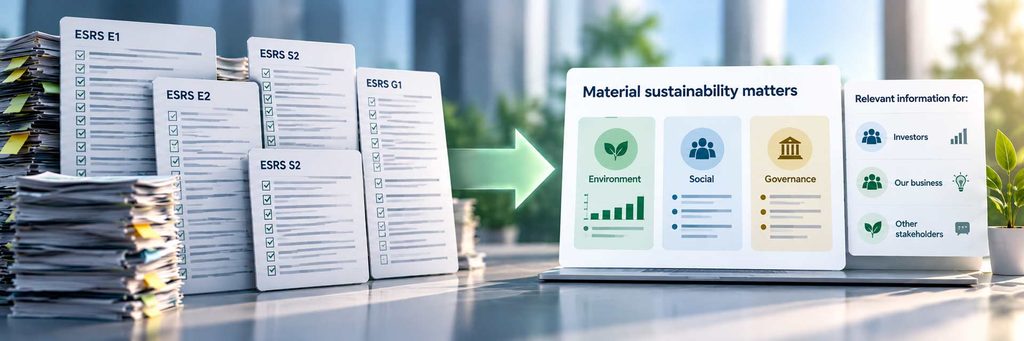
3. There is a stronger focus on material information
Materiality also applied under the old ESRS. But reporting could easily turn into a long exercise of going through disclosure requirements and datapoints.
The revised ESRS makes the materiality of information clearer.
A datapoint does not automatically need to be reported just because it exists in ESRS. The information also needs to be material.
This moves the focus from “Which boxes do we need to fill?” towards “What information do users and our business need to understand our material sustainability matters?”
4. Fair presentation is now an explicit principle
The old ESRS already required sustainability information to have qualities such as relevance, accuracy and completeness.
The revised ESRS makes fair presentation an explicit overall principle.
Companies need to consider whether their sustainability statement as a whole gives a fair picture of their material impacts, risks and opportunities.
This is important because the revised ESRS gives companies more flexibility. More flexibility also means more judgement about what information needs to be included.

5. You don’t always need to search for information at any cost
Under the old ESRS, finding some required information could involve a lot of work, especially when information was not already available.
The revised ESRS introduces the principle of “reasonable and supportable information available without undue cost or effort” in several areas.
In simple terms, companies are not always expected to carry out an exhaustive search or build an expensive new data process to find information. The company still needs a good reason for using this relief, and what counts as undue cost or effort depends on its situation.

6. Estimates can be used more practically
The old ESRS could create difficult data collection work when direct information was not available, especially in the value chain.
The revised ESRS gives companies more practical ways to use estimates and other reasonable information when reliable direct data is not available.
For example, materiality assessment of the value chain can in some situations use sector data, regional data or other generally available information instead of direct information from every value-chain company. This can reduce the need to chase information that is very difficult to obtain.

7. Value-chain information is easier to handle
Value-chain reporting was one of the difficult areas under the old ESRS. Companies could need information from suppliers and other business partners even when that information was difficult to obtain.
The revised ESRS simplifies several value-chain requirements and provides clearer reliefs for situations where information is not available. At the same time, the wider CSRD framework introduces a value-chain cap that limits what sustainability information large reporting companies can require from certain smaller companies for their CSRD reporting.
For ESG managers, this is a good reason to review existing supplier questionnaires and data requests.

8. Companies have more flexibility over the level of detail
Under the old ESRS, companies could end up assessing sustainability matters at a very detailed level by location, activity or business unit.
The revised ESRS gives companies more judgement over aggregation and disaggregation. Importantly, doing the materiality assessment at a detailed level does not automatically mean that the information must be reported at the same detailed level. E.g. some data might be collected just for the internal business use.
The report should use the level of detail needed to understand the material matter.

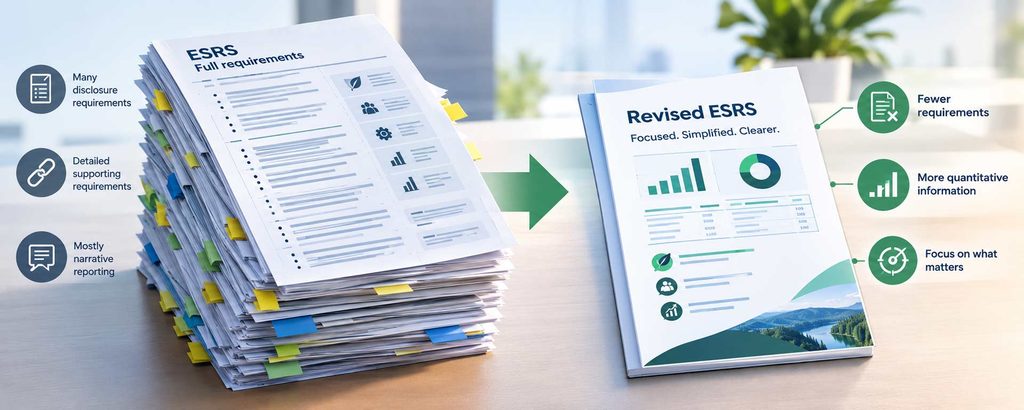
9. Disclosure requirements are shorter and more focused
The original ESRS included many detailed disclosure requirements and supporting requirements.
The revised standards remove, combine and simplify many of them. The EU has also given more priority to quantitative information instead of extensive narrative reporting.
This means ESG teams should review their existing reporting templates instead of assuming that all old reporting requirements are still needed. Before removing data collection, check whether the underlying information is still needed elsewhere in ESRS or for the business.
10. Voluntary “may” datapoints have been removed
The old ESRS included many datapoints that companies may disclose voluntarily. This could make it harder to see the difference between what was required and what was optional.
The revised standards remove these voluntary “may” datapoints from ESRS and make the difference between mandatory and voluntary information clearer.
Companies can still report additional information when it is useful. It is simply clearer what ESRS itself requires.

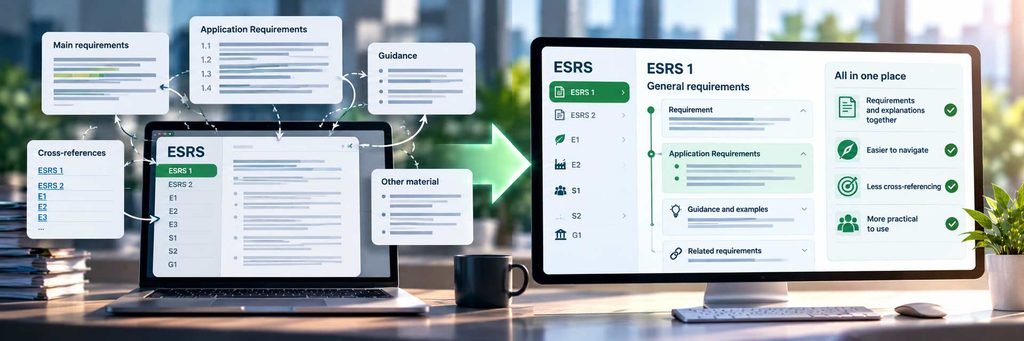
11. Application Requirements are easier to use
The old standards contained extensive Application Requirements that supported the main disclosure requirements. Using the standards often meant moving between the main requirements and separate supporting material.
The revised ESRS reduces and reorganises this material and connects the Application Requirements more closely with the requirements they explain.
This should make the standards easier to navigate when ESG teams are working with them in practice.
12. There is more flexibility in how the sustainability statement is presented
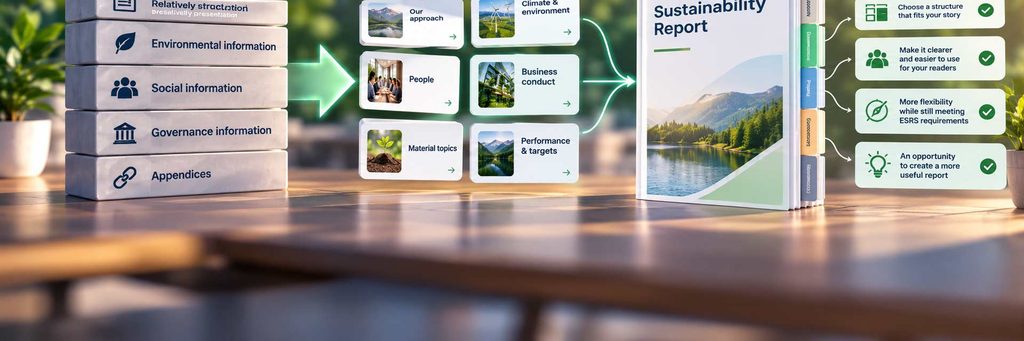
The old ESRS had a relatively structured approach to how sustainability information should be presented.
The revised ESRS gives companies more flexibility in organising their sustainability statement. The aim is still to make the information clear, understandable and easy to find. But companies have more room to choose a structure that works for their reporting.
This creates an opportunity to make sustainability reports easier to use, not only easier to produce.
13. Anticipated financial effects become more practical
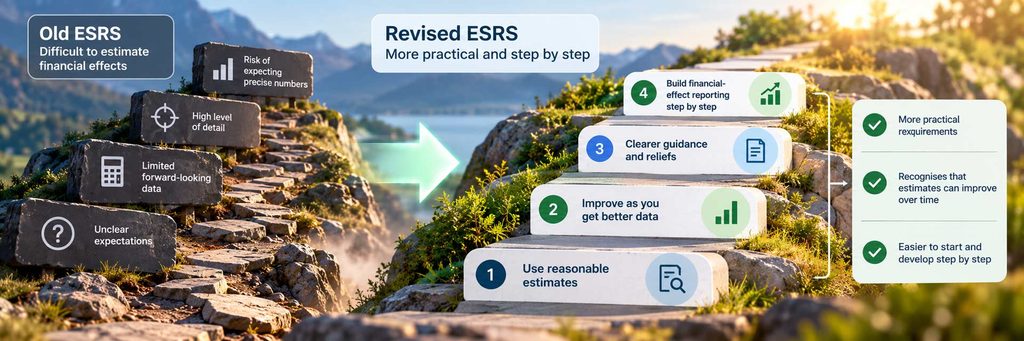
Reporting the expected financial effects of sustainability risks and opportunities has been one of the difficult parts of ESRS, especially when reliable forward-looking numbers are not yet available.
The revised ESRS clarifies these requirements and provides additional relief. It also recognises that estimates can improve as companies get better information and develop their methods.
This should make it easier to build financial-effect reporting step by step instead of expecting perfect information immediately.
14. There is more flexibility in GHG reporting boundaries
Companies may already calculate greenhouse gas emissions using established GHG accounting processes. The old ESRS could create differences between those processes and the reporting boundary required for ESRS.
The revised ESRS provides more flexibility. Depending on the situation, companies can use either the financial control or operational control approach when determining the GHG reporting boundary.
ESG teams should therefore check whether their existing GHG accounting process can now be aligned more closely with ESRS reporting.

15. Climate transition plan requirements are clearer
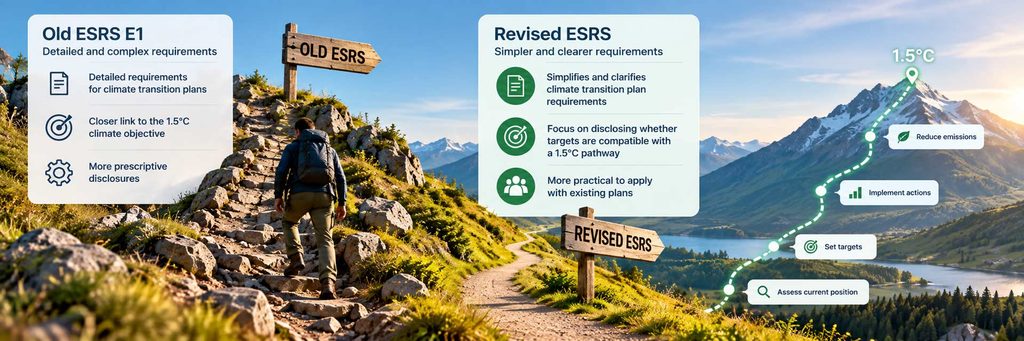
The old ESRS E1 included detailed requirements around climate transition plans and their relationship with the 1.5°C climate objective.
The revised ESRS simplifies and clarifies these requirements.
One important clarification is the focus on disclosing whether climate targets are compatible with a 1.5°C pathway, rather than requiring companies to state that their targets are aligned with that pathway.
Companies with an existing climate transition plan should therefore review their current disclosures against the revised E1 requirements.
16. Acquisitions and disposals are easier to handle
Acquisitions and disposals can make sustainability reporting difficult. A company may not have complete historical information about a newly acquired business, or it may no longer have access to information from a business it has sold.
The revised ESRS introduces clearer relief for these situations.
This reduces the need to reconstruct information that may be difficult or impossible to obtain and gives companies a more practical way to deal with changes in the reporting group.

The biggest change is not just having fewer datapoints

The revised ESRS clearly reduce the amount of reporting work.
But companies should be careful not to approach the change by simply taking their old ESRS checklist and deleting the datapoints that are no longer required.
Many datapoints have been removed or combined because they contained overlapping information, while much of the underlying sustainability data remains relevant.
The revision creates a bigger opportunity.
Companies can review how they assess materiality, what information they collect, who they ask for it, how much detail they need and how they present the final information.
Some information that is no longer required by ESRS may still be useful for management, customers, investors or other business decisions. That information does not need to disappear.
The goal should therefore not be:
“How much reporting can we remove?”
A better question is:
“How can we spend less time on reporting work that adds little value and more time on sustainability information that matters?”
For ESG managers, this may be the most important opportunity created by the revised ESRS.
Learn More