


ESG Ahead Briefing
This content requires a membership. Please, log in or subscribe a Premium plan to continue and see the whole content.
Key Takeaways
Full Article
Why do you still need sustainability information from suppliers?
You still need supplier data, but don’t ask for more than you need.
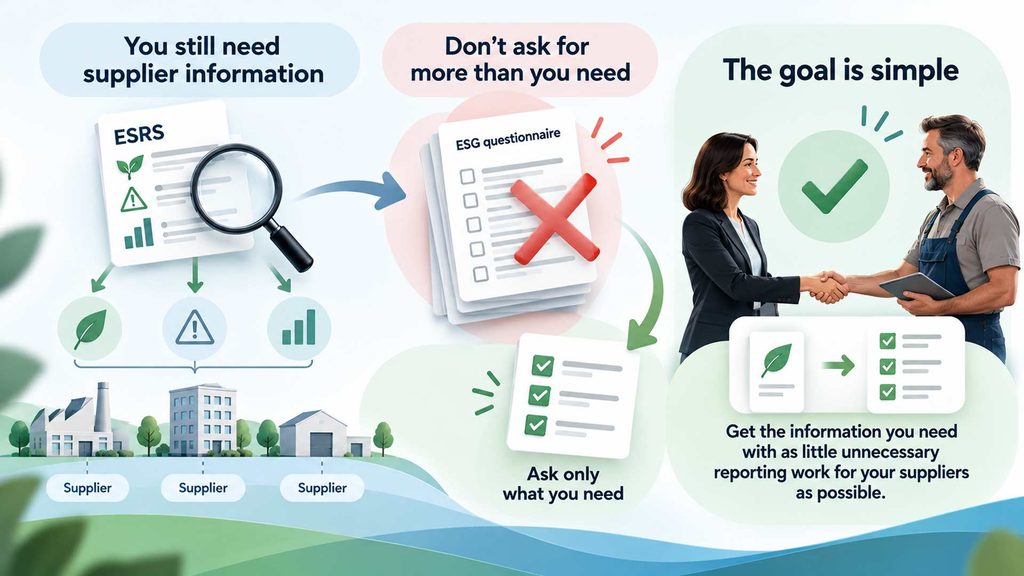
The revised ESRS do not remove the need for value-chain information. You may still need sustainability information from suppliers to report your material impacts, risks and opportunities.
But the approach has changed.
Don’t start by sending every supplier a long ESG questionnaire.
First ask what information you actually need for your ESRS reporting. Then check whether you need to get it directly from the supplier.
The goal is simple:
Get the information you need while creating as little unnecessary reporting work for your suppliers as possible.
The revised ESRS support this approach by allowing companies, in certain situations, to use estimates and other reasonable information instead of collecting everything directly from suppliers. And the new value-chain cap limits what information smaller companies can be required to provide for your CSRD reporting.
So the starting point is not:
“What can we ask our suppliers?”
It is:
“What information do we really need and what is the easiest reliable way to get it?”
You can reduce the reporting work you ask suppliers to do
The revised ESRS give you more flexibility in how you get value-chain information.
You don’t always need to ask suppliers directly. In some situations, you can use information you already have, sector or regional data, estimates or other reliable sources.
This creates an opportunity to reduce the reporting work you ask your suppliers to do.
Before sending a data request, ask yourself:
Do we really need this information directly from the supplier, or can we get reliable information another way without too much cost or effort?
If you can get the information another reasonable and reliable way, avoid asking the supplier for it. This matters especially for smaller suppliers. They already spend time serving their customers and running their business. Avoid creating reporting work that you don’t actually need.
So don’t start with:
“What sustainability information can we ask our suppliers for?”
Start with:
“What information do we need, and what is the simplest reliable way to get it?”
Why the EU introduced the value-chain cap
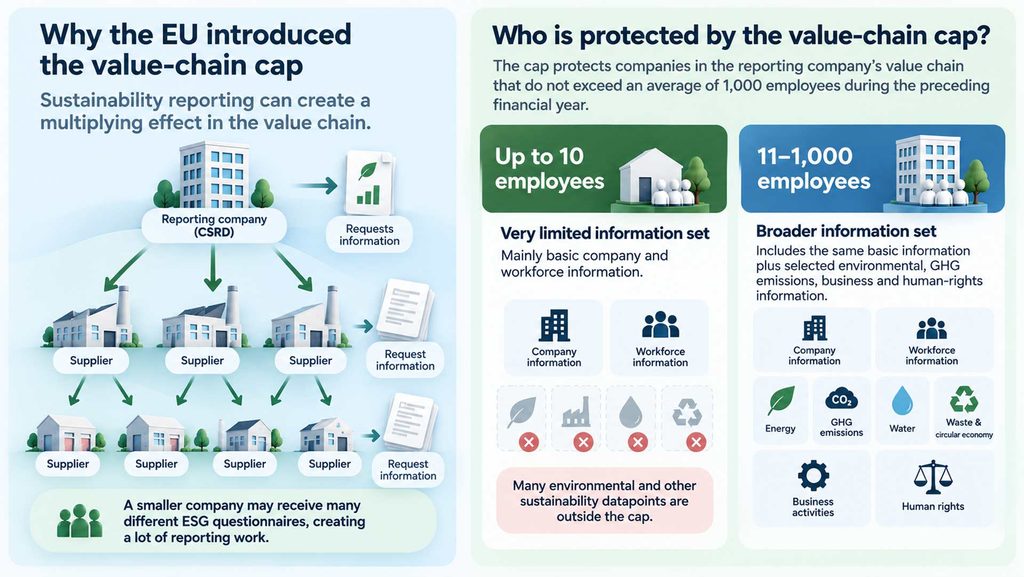
Sustainability reporting can create a multiplying effect in the value chain.
A large company needs information for its CSRD reporting and asks its suppliers. Those suppliers may need information from their own suppliers. And a smaller company serving several large customers may receive many different ESG questionnaires asking for similar information. This can create a lot of reporting work for companies that are not themselves required to report under CSRD.
The EU calls this the trickle-down effect and has introduced the value-chain cap to limit it. The cap sets a maximum for what CSRD-reporting companies can require from protected smaller companies for their sustainability reporting.
It applies from financial years beginning on or after 1 January 2027.
Who is protected by the value-chain cap?
You can normally trust the supplier’s own information about its size. You only need to check it if it seems clearly wrong.
The value-chain cap protects companies in the reporting company’s value chain that do not exceed an average of 1,000 employees during the preceding financial year.
There are two groups, and the amount of information you can require is different for each:
- Up to 10 employees:
The cap is very limited. It mainly covers basic company and workforce information.
Many environmental and other sustainability datapoints are outside the cap for these smallest companies. - 11–1,000 employees:
The cap is broader. In addition to the basic company and workforce information, it includes selected information about energy, GHG emissions, water, waste, circular economy, business activities and human rights.
So before deciding what sustainability information you can require from a smaller supplier, first check which of these two groups it belongs to.
The cap is a maximum — not a questionnaire
Annex II defines the maximum information you can require from protected suppliers for CSRD reporting. It is not a list you should automatically send to every supplier.
The principle is simple:
Ask only for the information you actually need. If you need less than the cap allows, ask for less.
So start with:
“What information do we actually need?”
Then check:
“Is it within the value-chain cap?”
What information is inside the value-chain cap?
Annex II defines what information is inside the value-chain cap.
There are two levels:
- Up to 10 employees:
A limited set of company and workforce information. - 11–1,000 employees:
All the same information plus selected environmental, business, workforce and human-rights information.
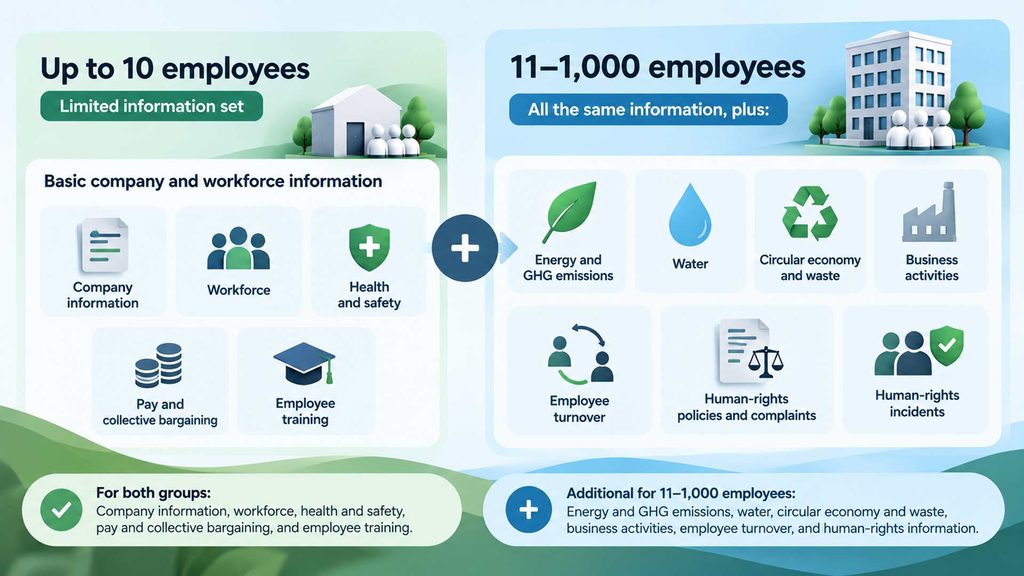
Let’s look at what is included.
For all companies with up to 1,000 employees
The following information is inside the cap for both groups.
1. Reporting and company information
This tells you who the supplier is, what it does and what its sustainability information covers.
You can require information about:
- whether it uses the Basic Module or both the Basic and Comprehensive Modules of the Voluntary Standard;
- whether the information covers one company or a consolidated group;
- legal form;
- NACE sector code or codes;
- total assets;
- turnover;
- number of employees;
- country of primary operations;
- location of significant assets; and
- geolocation of sites owned, leased or managed.
2. Workforce information
This gives you a basic picture of the supplier’s workforce.
You can require:
- number of permanent employees;
- number of temporary employees; and
- number of employees by gender.
Employee numbers can be reported as headcount or full-time equivalents.
3. Health and safety
This gives you basic information about work-related accidents.
You can require:
- number of recordable work-related accidents; and
- rate of recordable work-related accidents.
4. Pay and collective bargaining
You can require information about:
- whether employees are paid at least the applicable minimum wage; and
- percentage of employees covered by collective bargaining agreements.
5. Employee training
You can require:
- average annual training hours per employee.
For companies with up to 10 employees, the value-chain cap ends here.
For companies with 11–1,000 employees
For this group, all the information above is included, plus the following information.
6. Energy and GHG emissions
You can require:
- total energy consumption in MWh;
- estimated absolute gross Scope 1 GHG emissions; and
- location-based Scope 2 GHG emissions.
The emissions are reported in tonnes of CO2 equivalent.
Scope 3 emissions are not included in the value-chain cap.
7. Water
You can require:
- total water withdrawal.
This measures how much water is drawn into the company’s operations.
8. Circular economy and waste
You can require information about:
- whether the company applies circular-economy principles;
- how it applies them;
- total waste generated;
- hazardous waste;
- non-hazardous waste; and
- proportion of waste diverted to recycling or preparation for reuse.
9. Business activities
This helps you understand what the supplier does and how it operates.
You can require information about:
- significant products and services;
- significant markets, such as B2B, wholesale, retail and relevant countries; and
- main business relationships, such as key suppliers, customers and distribution channels.
10. Employee turnover
You can require:
- employee turnover rate for the reporting period.
11. Human-rights policies and complaints
You can require information about:
- whether the company has a code of conduct or human-rights policy for its own workforce; and
- whether it has a complaints-handling mechanism for its own workforce.
These are basic yes/no disclosures.
12. Human-rights incidents
You can require information about confirmed incidents involving the company’s own workforce related to:
- child labour;
- forced labour;
- human trafficking;
- discrimination; and
- other human-rights-related incidents.
You can also require information on whether the company is aware of confirmed human-rights incidents involving:
- workers in its value chain;
- affected communities;
- consumers; or
- end-users.
For this last group, the cap covers whether confirmed incidents exist, not a detailed description of those incidents.
The difference in one sentence
- Up to 10 employees:
Mainly company and basic workforce information. - 11–1,000 employees:
The same information plus selected environmental, business, workforce and human-rights information.
What information is outside the value-chain cap?
The full Voluntary Standard contains more sustainability information than the value-chain cap.
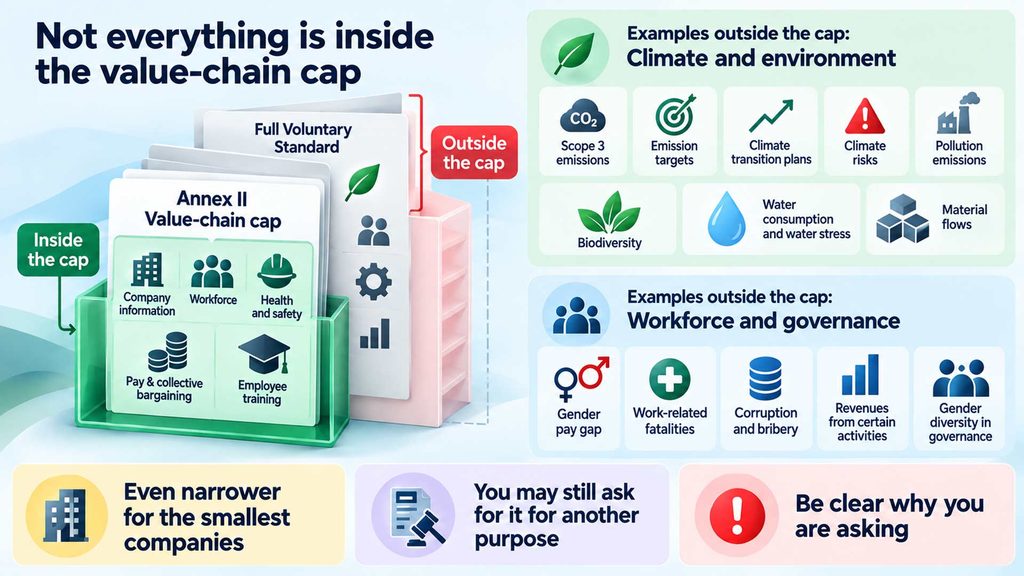
The difference is important:
The Voluntary Standard and the value-chain cap are not the same thing.
Only the datapoints specifically included in Annex II are part of the cap. This means several types of sustainability information are outside it.
Climate and environment
The cap does not include, for example:
- Scope 3 GHG emissions;
- GHG reduction targets;
- climate transition plans;
- climate-risk information;
- pollution emissions;
- biodiversity-sensitive sites;
- water consumption and separate water-stress information; and
- detailed material-flow information.
Workforce and governance
The cap also does not include, for example:
- gender pay gap;
- work-related fatalities and fatalities from work-related ill health;
- convictions and fines for corruption and bribery;
- revenues from certain activities; and
- gender diversity in the governance body.
These are examples, not a complete list of everything outside Annex II.
The cap is even narrower for the smallest companies
For companies with up to 10 employees, environmental, business and human-rights information included in the cap for companies with 11–1,000 employees is also outside their cap.
So always check which size group the supplier belongs to.
Outside the cap does not always mean you cannot ask
This distinction is important. The value-chain cap limits what you can require from protected companies for your CSRD sustainability reporting.
Information outside the cap may still be requested for another purpose, for example to meet requirements under other EU or national laws.
So before asking for information outside the cap, be clear about why you need it.
Don’t treat information needed for another purpose as information the supplier must provide for your CSRD reporting.
What happens if your CSRD request exceeds the cap?
A protected supplier has the right to decline information requests that exceed the value-chain cap when the information is requested for your CSRD reporting. You cannot get around the cap through contracts or other arrangements for your CSRD reporting.
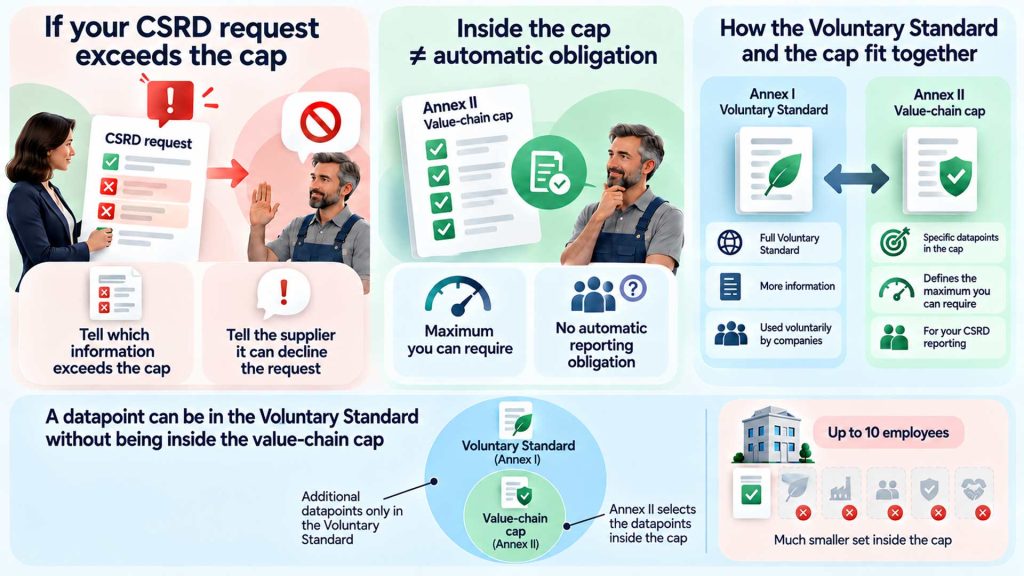
If you ask for CSRD-related information that exceeds the cap, you must tell the supplier:
- which information is outside the cap; and
- that it has the right to decline the request.
The supplier can still choose to provide additional information voluntarily.
There is also another important point:
Being inside the cap does not automatically mean that the supplier must provide the information.
The cap defines the maximum you can require for CSRD reporting. It does not create a new reporting obligation for every smaller supplier.
How does the Voluntary Standard fit in?
The EU Voluntary Sustainability Reporting Standard gives companies outside mandatory CSRD reporting a common way to report sustainability information.
But the Voluntary Standard and the value-chain cap are not the same thing.
The regulation separates them into two annexes:
Annex I: Voluntary Standard
This contains the full Voluntary Sustainability Reporting Standard.
Companies can use it voluntarily to prepare and share sustainability information in a common EU format.
Annex II: Value-chain cap
This contains the specific datapoints that define the value-chain cap.
Only these datapoints determine the maximum information protected companies can be required to provide for a customer’s CSRD reporting.
So the key distinction is: A datapoint can be in the Voluntary Standard without being inside the value-chain cap.
This is particularly important for companies with up to 10 employees, because their value-chain cap covers a much smaller set of information.
The goal is not to ask for as much as the cap allows
The value-chain cap gives companies a clearer boundary for supplier sustainability information.
But that boundary should not become the new standard supplier questionnaire.
The regulation itself makes clear that reporting companies should ask value-chain companies only for the information they need and should request less than the maximum where they do not need everything covered by the cap.
So the goal is not:
“What is the maximum sustainability information we can ask this supplier for?”
A better question is:
“What sustainability information do we actually need, and what is the simplest reliable way to get it?”
That can reduce unnecessary reporting work for suppliers and for the ESG teams that have to collect, check and use the information.
Ask for the information you need, from the suppliers you need it from, and don’t create reporting work that adds no value.
Learn More
Want to go deeper? These sources provide the official rules and more background on the revised ESRS.
Coming Soon in ESG Ahead:
COMING SOON
- ESG Ahead — The Revised ESRS Are Finally Here — What Happens Next?
A quick overview of the final revised ESRS, when the new standards apply and what ESG managers should do next.
Read the ESG Ahead briefing - What actually changed in the revised ESRS?
The most important changes and what they mean for your reporting work.
Read the ESG Ahead briefing - What does the new voluntary standard mean for SMEs?
How smaller companies can prepare for customer requests and tenders.
Read more: